
The Chariot - Tarot Card Interpretation by A. E. Waite
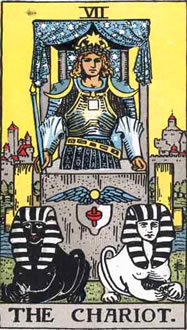
An erect and princely figure carrying a drawn sword and corresponding, broadly speaking, to the traditional description which I have given in the first part. On the shoulders of the victorious hero are supposed to be the Urim and Thummim. He has led captivity captive; he is conquest on all planes--in the mind, in science, in progress, in certain trials of initiation. He has thus replied to the sphinx, and it is on this account that I have accepted the variation of Éliphas Lévi; two sphinxes thus draw his chariot. He is above all things triumph in the mind.
It is to be understood for this reason (a) that the question of the sphinx is concerned with a Mystery of Nature and not of the world of Grace, to which the charioteer could offer no answer; (b) that the planes of his conquest are manifest or external and not within himself; (c) that the liberation which he effects may leave himself in the bondage of the logical understanding; (d) that the tests of initiation through which he has passed in triumph are to be understood physically or rationally; and (e) that if he came to the pillars of that Temple between which the High Priestess is seated, he could not open the scroll called Torah nor if she questioned him could he answer. He is not hereditary royalty and he is not priesthood.
Divinatory Meaning: Succour, providence also war, triumph, presumption, vengeance, trouble.
Reversed: Riot, quarrel, dispute, litigation, defeat.
Tarot Card Intertpretations by A. E. Waite
Cards of The Tarot Major Arcana
The Fool The Magician The High Priestess The Empress The Emperor The Hierophant The Lovers The Chariot Strength The Hermit Wheel of Fortune Justice The Hanged Man Death Temperance The Devil The Tower The Star The Moon The Sun Judgment The World
Cards of The Tarot Wands
Ace, Two, Three, Four, and Five of Wands Six, Seven, Eight, Nine, and Ten of Wands Page, Knight, Queen, and King of Wands
Cards of The Tarot Cups
Ace, Two, Three, Four, and Five of Cups Six, Seven, Eight, Nine, and Ten of Cups Page, Knight, Queen, and King of Cups
Cards of The Tarot Swords
Ace, Two, Three, Four, and Five of Swords Six, Seven, Eight, Nine, and Ten of Swords Page, Knight, Queen, and King of Swords
Cards of The Tarot Pentacles (Disks)
Ace, Two, Three, Four, and Five of Pentacles Six, Seven, Eight, Nine, and Ten of Pentacles Page, Knight, Queen, and King of Pentacles